Choosing the right professional kitchen scissors for commercial sourcing requires more than picking a popular model. This guide covers the key factors that serious buyers evaluate when sourcing kitchen scissors at scale.
Blade Steel: The Foundation of Performance
The steel grade determines edge retention, corrosion resistance, and long-term durability. For professional kitchen scissors, look for high-carbon stainless steel grades such as 3Cr13, 5Cr15MoV, or German 1.4116. These grades offer a balance of hardness and corrosion resistance suited to commercial kitchen environments.
Lower-grade stainless steel (such as 2Cr13) is adequate for occasional household use but dulls faster under sustained cutting load and is more susceptible to corrosion from food acids and repeated washing.
Construction: What to Look For
Blade alignment is the most critical construction factor. Misaligned blades cause tearing rather than clean cuts and accelerate blade wear. Check alignment by closing the scissors slowly — blades should meet evenly from tip to pivot with no gap or crossing.
The pivot mechanism should be adjustable. A precision-machined screw pivot allows blade tension to be maintained as the scissors wear in. Rivet pivots are common in household scissors but are not adjustable and cannot be serviced.
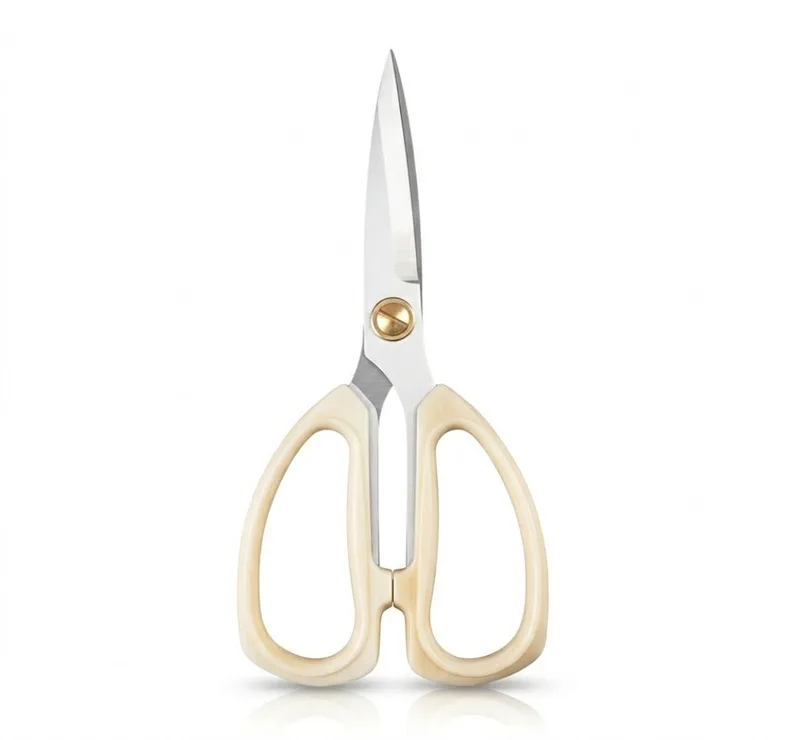
Adjustable screw pivot on professional-grade shears
Certifications: Market Entry Requirements
For the US market, food-contact components should comply with FDA regulations. For the EU, LFGB certification (Germany) is the standard most professional buyers require. CE marking applies to certain product categories. Confirm which certifications your target market requires before placing a production order — retrofitting certification after manufacturing is costly.
Handle Design and Ergonomics
Professional scissors are used for extended periods in commercial kitchens. Handle ergonomics affect fatigue and efficiency over a full shift. Evaluate finger ring size (too small causes fatigue; too large reduces control), grip material (soft-touch TPR reduces hand fatigue vs. hard ABS or PP), and weight distribution (blade-heavy scissors require more effort to open).
Sourcing Considerations for B2B Buyers
When evaluating suppliers, request samples of at least three to five units to assess production consistency. Single-unit samples can hide variability. Ask for documentation of steel certification, hardness testing (target HRC 52–58 for kitchen scissors blades), and existing buyer references in your market.
MOQ varies by customization level. Standard ODM scissors from established factories typically start at 500–1,000 units. Custom OEM scissors with proprietary blade geometry or handle design typically require 2,000–5,000 units minimum to justify tooling investment.
Products Mentioned in This Guide
Sourcing scissors, knives or kitchenware?
Tell us your product, quantity and branding needs — we reply within 24 hours. OEM/ODM, private label and sample orders available.